3D printing, also known as additive manufacturing, is transforming the landscape of custom manufacturing in ways that were not possible just a decade ago. By building objects layer by layer from digital designs, this technology eliminates many of the limitations associated with traditional manufacturing methods. As a result, businesses and individuals now have greater flexibility, efficiency, and creative freedom than ever before.
One of the most significant advantages of 3D printing is the reduction of setup costs and time. Traditional manufacturing processes such as injection molding or CNC machining often require specialized tooling, molds, and extensive preparation. These steps can be both time-consuming and expensive, especially for small production runs or one-off custom pieces. In contrast, 3D printing allows manufacturers to move directly from a digital design to a physical object with minimal preparation, making it ideal for custom and low-volume production.
Another key benefit is the unprecedented level of design freedom. Complex geometries, including internal channels, intricate lattice structures, and organic shapes, are difficult or even impossible to achieve using conventional methods. With 3D printing, these designs can be produced without additional cost or complexity. This enables engineers and designers to focus more on optimizing performance and functionality rather than being constrained by manufacturing limitations.
Another key benefit is the unprecedented level of design freedom. Complex geometries, including internal channels, intricate lattice structures, and organic shapes, are difficult or even impossible to achieve using conventional methods. With 3D printing, these designs can be produced without additional cost or complexity. This enables engineers and designers to focus more on optimizing performance and functionality rather than being constrained by manufacturing limitations.
Speed is also a major factor in the growing adoption of 3D printing. Prototyping, which once took days or even weeks, can now be completed in a matter of hours. This rapid turnaround allows for faster testing, iteration, and refinement of designs. As a result, companies can accelerate their product development cycles and bring innovations to market more quickly.
Customization is where 3D printing truly stands out. Unlike traditional manufacturing, where producing unique variations can be costly, 3D printing allows each item to be different without significantly increasing production costs. This capability is particularly valuable in industries such as healthcare, where custom prosthetics and implants can be tailored to individual patients, as well as in automotive and aerospace sectors that require specialized components.
In addition to its flexibility and efficiency, 3D printing also contributes to sustainability. Because it uses only the material necessary to build each object, it generates less waste compared to subtractive manufacturing processes. This can lead to cost savings and a reduced environmental impact over time.
Why this matters:
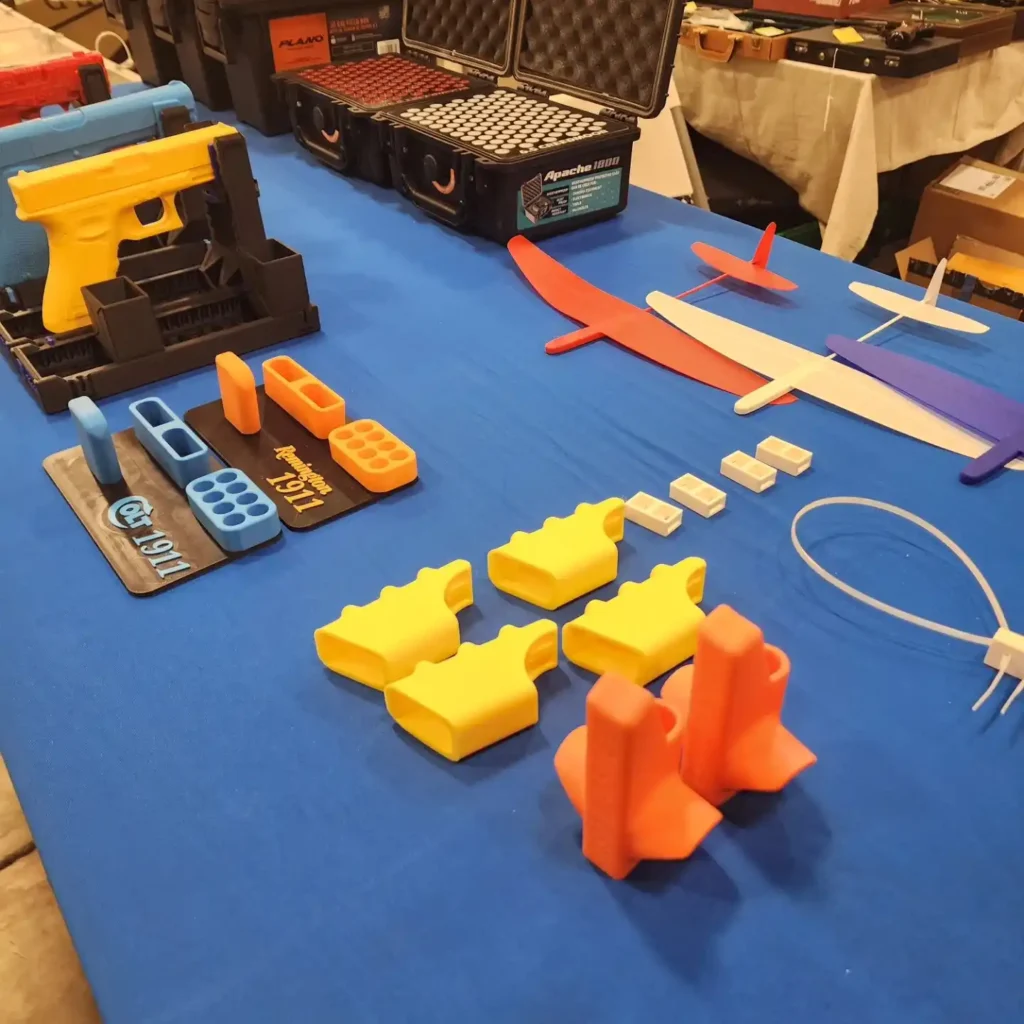
- Hyper-Personalization: Traditionally, manufacturing required expensive molds and massive factories. Now, if a creator wants a specific texture or a unique ergonomic fit for a grip, they can iterate the design in the morning and have the physical part by the afternoon.
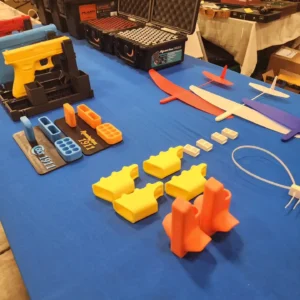
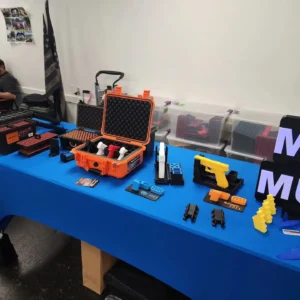
- Prototyping at Scale: You can see the evolution of design in the different iterations on the table. It allows for testing form, fit, and function without the massive overhead costs.
- Training & Safety: Using high-quality 3D-printed “blue guns” or dummy models (like the yellow trainer in the photo) provides a safe, weight-accurate way to practice handling and holster fits.
- Supports on-demand production, reducing the need for large inventories and minimizing storage costs
- Shifts the industry from mass production toward mass customization, making products more personalized and adaptable
Despite its many advantages, 3D printing is not a complete replacement for traditional manufacturing. Methods like CNC machining still offer superior precision, material options, and efficiency for large-scale production. However, 3D printing complements these techniques by excelling in areas such as rapid prototyping, complex designs, and small-batch manufacturing.
In conclusion, 3D printing is redefining custom manufacturing by making it more accessible, flexible, and efficient. It empowers businesses of all sizes to create high-quality, customized products on demand, ultimately reshaping how goods are designed, developed, and produced in the modern world.